OAuth 2.0
Casdoor issues access tokens for authenticating clients. This page describes how to get a token via the API, verify it, and use it. Alternatively use Casdoor SDKs to handle the flow.
Supported grant types: Authorization Code, Implicit, Resource Owner Password, Client Credentials, Refresh Token, Device Authorization, Token Exchange.
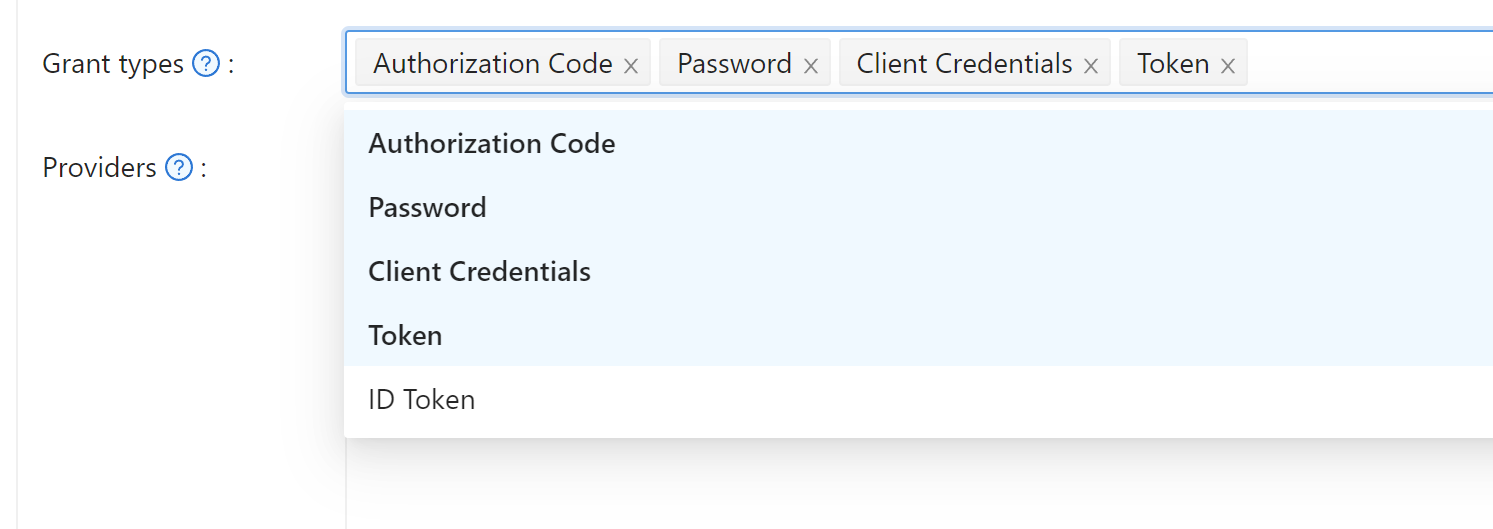
Authorization code is enabled by default for security. Enable other grant types on the application edit page if needed.
Authorization code grant
Redirect the user to:
https://<CASDOOR_HOST>/login/oauth/authorize?
client_id=CLIENT_ID&
redirect_uri=REDIRECT_URI&
response_type=code&
scope=openid&
state=STATE
Scopes
| Scope | 描述 |
|---|---|
| openid (default) | sub, iss, aud |
| profile | name, displayName, avatar |
| email address | |
| address | address (OIDC object in JWT-Standard; see OIDC address claim) |
| phone | phone number |
%20:https://<CASDOOR_HOST>/login/oauth/authorize?
client_id=...&
scope=openid%20email
See the OIDC spec for details.
After the user signs in, Casdoor redirects to:
https://REDIRECT_URI?code=CODE&state=STATE
Exchange the code for tokens with a POST to:
https://<CASDOOR_HOST>/api/login/oauth/access_token
Request body:
{
    "grant_type": "authorization_code",
    "client_id": ClientId,
    "client_secret": ClientSecret,
    "code": Code,
}
Example response:
{
    "access_token": "eyJhb...",
    "id_token": "eyJhb...",
    "refresh_token": "eyJhb...",
    "token_type": "Bearer",
    "expires_in": 10080,
    "scope": "openid"
}
Casdoor supports PKCE (Proof Key for Code Exchange) for enhanced security. To enable PKCE, add two parameters when requesting the authorization code:
&code_challenge_method=S256&code_challenge=YOUR_CHALLENGE
The code challenge should be a Base64-URL-encoded SHA-256 hash of your randomly generated code verifier (43-128 characters). When requesting the token, include the original code_verifier parameter. With PKCE enabled, client_secret becomes optional, but if provided, it must be correct.
For OAuth providers configured in Casdoor (like Twitter and custom providers with PKCE enabled), Casdoor automatically generates unique code verifiers for each authentication flow, so you don't need to manually implement PKCE.
Binding Tokens to Specific Services
When your application needs to call multiple backend services, you might want tokens that are explicitly bound to a specific service. This prevents security issues where a token meant for one service could accidentally be used with another.
Casdoor supports RFC 8707 Resource Indicators, which lets you specify the intended service when requesting authorization. Add the resource parameter with an absolute URI identifying your service:
https://<CASDOOR_HOST>/login/oauth/authorize?
client_id=CLIENT_ID&
redirect_uri=REDIRECT_URI&
response_type=code&
scope=openid&
state=STATE&
resource=https://api.example.com
When you exchange the authorization code for tokens, include the same resource parameter:
{
    "grant_type": "authorization_code",
    "client_id": ClientId,
    "client_secret": ClientSecret,
    "code": Code,
    "resource": "https://api.example.com"
}
The resulting access token will have its aud (audience) claim set to your resource URI instead of the client ID. Your backend service can then verify that tokens were issued specifically for it by checking the audience claim. The resource must match exactly between the authorization and token requests.
Signup Flow with OAuth
When users sign up through the OAuth authorization flow, they are automatically redirected to your application's callback URL with the authorization code, just like the sign-in flow. Previously, users had to manually click through intermediate pages after creating their account. Now the signup process matches the streamlined experience of signing in—once registration completes, Casdoor immediately generates the authorization code and redirects to your redirect_uri.
Your application doesn't need any changes to support this. The authorization parameters (client_id, response_type, redirect_uri, etc.) are automatically passed through the signup process when users choose to create a new account during OAuth authorization.
隐式授权
For apps without a backend, use Implicit Grant. Enable it on the application, then redirect users to:
https://<CASDOOR_HOST>/login/oauth/authorize?client_id=CLIENT_ID&redirect_uri=REDIRECT_URI&response_type=token&scope=openid&state=STATE
当您的用户通过 Casdoor 身份验证后,他会被 Casdoor 重定到:
https://REDIRECT_URI/#access_token=ACCESS_TOKEN
Casdoor也支持id_token作为response_type,这是OpenID的一个特性。
Device Grant
For devices with limited input or no browser, use Device Grant. Enable it on the application, request device_authorization_endpoint from OIDC discovery, then show verification_uri (e.g. via QR or text) so the user can complete login.
Second, you should request token endpoint to get Access Token with parameter define in rfc8628.
使用资源拥有者的密码凭据授权
如果您的应用程序没有前端来重定向用户到Casdoor,那么您可能需要这个功能。
Enable Password Credentials Grant on the application, then send a POST request to:
https://<CASDOOR_HOST>/api/login/oauth/access_token
{
    "grant_type": "password",
    "client_id": ClientId,
    "client_secret": ClientSecret,
    "username": Username,
    "password": Password,
}
Example response:
{
    "access_token": "eyJhb...",
    "id_token": "eyJhb...",
    "refresh_token": "eyJhb...",
    "token_type": "Bearer",
    "expires_in": 10080,
    "scope": "openid"
}
使用客户端凭据授权
Use Client Credentials Grant when the application has no frontend.
Enable Client Credentials Grant on the application and send a POST request to https://<CASDOOR_HOST>/api/login/oauth/access_token:
{
    "grant_type": "client_credentials",
    "client_id": ClientId,
    "client_secret": ClientSecret,
}
Example response:
{
    "access_token": "eyJhb...",
    "id_token": "eyJhb...",
    "refresh_token": "eyJhb...",
    "token_type": "Bearer",
    "expires_in": 10080,
    "scope": "openid"
}
必须指出,以这种方式获得的AccessToken 不同于前三个,因为它与应用程序相对应,而不是与用户相对应。
刷新令牌
To refresh the access token, use the refreshToken obtained above.
Set the Refresh Token expiration in the application (default 0 hours), then send a POST request to https://<CASDOOR_HOST>/api/login/oauth/refresh_token
{
    "grant_type": "refresh_token",
    "refresh_token": REFRESH_TOKEN,
    "scope": SCOPE,
    "client_id": ClientId,
    "client_secret": ClientSecret,
}
Example response:
{
    "access_token": "eyJhb...",
    "id_token": "eyJhb...",
    "refresh_token": "eyJhb...",
    "token_type": "Bearer",
    "expires_in": 10080,
    "scope": "openid"
}
Token Exchange Grant
Token Exchange (RFC 8693) lets you swap an existing token for a new one with different characteristics—particularly useful when one service needs to call another on behalf of a user, or to narrow a token's scope for a specific downstream service.
To exchange a token, send a POST request to https://<CASDOOR_HOST>/api/login/oauth/access_token:
{
    "grant_type": "urn:ietf:params:oauth:grant-type:token-exchange",
    "client_id": ClientId,
    "client_secret": ClientSecret,
    "subject_token": SubjectToken,
    "subject_token_type": "urn:ietf:params:oauth:token-type:access_token",
    "scope": "openid email"
}
The subject_token is the token you want to exchange—typically an access token or JWT you already have. If you want to narrow the permissions in the new token, specify a scope that's a subset of the original token's scope. When you omit scope, the new token inherits the same scope as the subject token.
Casdoor supports three token types for subject_token_type:
urn:ietf:params:oauth:token-type:access_token(default)urn:ietf:params:oauth:token-type:jwturn:ietf:params:oauth:token-type:id_token
The response returns a new token tied to the same user as your subject token:
{
    "access_token": "eyJhb...",
    "id_token": "eyJhb...",
    "refresh_token": "eyJhb...",
    "token_type": "Bearer",
    "expires_in": 10080,
    "scope": "openid email"
}
For example, an API gateway might exchange a broad-scoped access token for a narrower one before forwarding requests to a downstream microservice. This pattern—called scope downscoping—ensures each service gets only the permissions it needs, rather than inheriting full access from the original token.
如何验证访问令牌
Casdoor 目前支持 令牌自省 端点。 此端点受基本身份验证保护(ClientId:ClientSecret)。
POST /api/login/oauth/introspect HTTP/1.1
Host: CASDOOR_HOST
Accept: application/json
Content-Type: application/x-www-form-urlencoded
Authorization: Basic Y2xpZW50X2lkOmNsaWVudF9zZWNyZXQ=

token=ACCESS_TOKEN&token_type_hint=access_token
Example response:
{
    "active": true,
    "client_id": "c58c...",
    "username": "admin",
    "token_type": "Bearer",
    "exp": 1647138242,
    "iat": 1646533442,
    "nbf": 1646533442,
    "sub": "7a6b4a8a-b731-48da-bc44-36ae27338817",
    "aud": [
        "c58c..."
    ],
    "iss": "http://localhost:8000"
}
如何使用AccessToken
Use the access token to call Casdoor APIs that require authentication.
例如,有两种不同的方式来请求/api/userinfo。
类型1:查询参数
https://CASDOOR_HOST/api/userinfo?accessToken=your_access_token
类型2:HTTP Bearer 令牌
https://CASDOOR_HOST/api/userinfo with the header: "Authorization: Bearer your_access_token"
Casdoor将解析access_token,并根据scope返回相应的用户信息。 The response has the same shape:
{
    "sub": "7a6b4a8a-b731-48da-bc44-36ae27338817",
    "iss": "http://localhost:8000",
    "aud": "c58c..."
}
If you expect more user information, add scope when obtaining the AccessToken in step Authorization code grant.
Accessing OAuth Provider Tokens
When users sign in via OAuth providers (GitHub, Google, etc.), the provider's access token is available to call the third-party API on their behalf; it is stored in the user's originalToken field.
The token is available through the /api/get-account endpoint:
{
  "status": "ok",
  "data": {
    "name": "user123",
    "originalToken": "ya29.a0AfH6SMBx...",
    ...
  }
}
The originalToken is visible only when the user requests their own account or when the requester is an admin. For other requests, it is masked for privacy.
This allows your application to interact with third-party APIs (e.g., GitHub API, Google Drive API) using the provider's access token without requiring additional OAuth flows.
userinfo 和 get-account APIs之间的差异
-
/api/userinfo:此API作为OIDC协议的一部分返回用户信息。 它提供有限的信息,包括仅在OIDC标准中定义的基本信息。 For a list of available scopes supported by Casdoor, see the Scopes section. -
/api/get-account:此API用于检索当前登录账户的用户对象。 It is a Casdoor-specific API that allows you to obtain all the information of the user in Casdoor, including the OAuth provider's access token when applicable.